

Thyroid Ultrasound
zł 250.00
The endocrine system plays a key role in regulating metabolism, mood, and overall body vitality. The most accessible, accurate, and rapid way to evaluate the condition of its primary organ is an ultrasound examination at the “Lekarze w Warszawie” medical center. It is a safe method to detect early abnormalities and prevent hormonal imbalances.
It is worth considering endocrine diagnostics if you experience the following symptoms:
Understanding when to have a thyroid ultrasound allows you to respond promptly to hidden signals from the body, even when early symptoms seem minor. Examination is also recommended during pregnancy planning, after prolonged hormone therapy, or if nodules are discovered during a routine checkup with an internist.
In addition to clear symptoms, regular screening is advised for individuals living in iodine-deficient areas and those with a genetic predisposition to endocrine disorders. A timely consultation with a sonologist allows you to monitor the condition and prevent the development of chronic diseases.
The procedure has no absolute contraindications. Ultrasound waves are completely safe for body tissues: they cause no thermal damage and involve no exposure to ionizing radiation. Rescheduling is necessary only in cases of fresh skin abrasions, open wounds, or burns on the neck that prevent proper contact of the ultrasound transducer.
The examination does not require strict dietary restrictions, special medications, or changes in fluid intake. Guidelines on how to prepare for a thyroid ultrasound involve just a few simple steps for maximum comfort:
Attention to these details ensures reliable diagnostic data, allowing the specialist to thoroughly analyze the function of the thyroid gland.
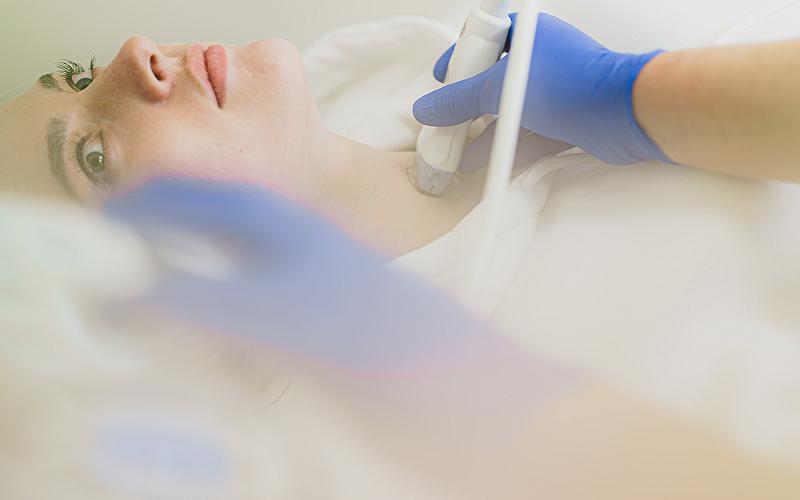
The visit takes place in an examination room where the patient lies on their back on an examination table. The procedure follows a standardized protocol: a soft pillow or roll is placed under the shoulders to slightly tilt the head back and expose the examination area, after which a layer of clear contact gel is applied to the skin. The physician moves the probe along the neck while the monitor displays a high-resolution, real-time cross-section of the tissue.
The ultrasound evaluation includes the following essential steps:
This systematic examination takes very little time and is completely stress-free. Immediately after the procedure, residual gel is easily removed with a disposable paper towel without leaving stains on clothing.
Healthy individuals without alarming symptoms should undergo this examination once every 12 months as part of a basic health checkup. For patients with pre-existing conditions, the frequency is determined by the attending endocrinologist—typically every six months to monitor therapeutic progress.
Transparent pricing for preventive healthcare enables you to manage your medical care predictably. Our clinic offers a fixed thyroid ultrasound price in Warsaw. It includes comprehensive imaging of both lobes, regional lymph node evaluation, high-resolution digital image prints, and a detailed official medical report.
Fees strictly follow our price list, with no hidden charges for interpreting findings or for disposable hygienic materials. A complete price list of combined packages is always available at the “Lekarze w Warszawie” reception desk.
A visit to our center guarantees high diagnostic precision and comfortable conditions throughout the examination. Patients trust us because of:
We respect our patients' time, which is why all appointments run on schedule without delays, and diagnostic findings are explained clearly along with a direct review of the scan.
To get a reliable ultrasound, you do not need to wait in long queues or obtain referrals from a general practitioner. Knowing where to have a thyroid ultrasound in Warsaw promptly makes it easy to schedule your visit for any day of the week. You can book an appointment online or by phone.
Yes, the examination is completely harmless. It is based on neutral sound waves rather than radiation. By choosing regular diagnostics, the patient is assured that a healthy thyroid on ultrasound is confirmed through a safe procedure. It can be performed without hesitation on pregnant women, nursing mothers, and young children.
The thyroid ultrasound examination itself is completely painless. The patient feels only the coolness of the contact gel and the gentle movement of the probe along the neck. Slight discomfort or a sensation of pressure can occur only during acute inflammation of the thyroid tissue or if the patient has a sensitive gag reflex when tilting the head back.
The scan visualizes diffuse or nodular goiters, cysts, adenomas, and inflammatory changes (such as in Hashimoto's thyroiditis). It is important to clarify whether a thyroid ultrasound directly reveals hypothyroidism: the device does not measure blood hormone levels, but it clearly identifies reduced gland volume or heterogeneous tissue architecture typical of this condition. For this reason, a referral for a thyroid ultrasound is often issued by an endocrinologist alongside blood tests for TSH, FT3, and FT4 to obtain a complete diagnosis.
A standard consultation in the ultrasound room typically takes between 15 and 20 minutes. This provides the sonologist with ample time to inspect all anatomical zones, record biometric measurements, save key images, and prepare a written report.
The target group for whom thyroid ultrasound indications are a priority includes patients aged 40 and older, menopausal women, individuals exposed to environmental hazards, and those with a family history of thyroid disease. Annual screenings are also recommended when frequently changing climate zones or living in areas with poor environmental conditions.
There is no need to wait for the results: the official thyroid ultrasound report is handed directly to the patient right after the procedure is finished. The doctor prints a complete report with ultrasound images and explains all findings in plain language.
We care for your health with full commitment and professionalism.
Thyroid Ultrasound
zł 250.00
Genitourinary ultrasound
zł 250.00
"3 Ultrasound Scans" Package (excluding heart and vessels)
zł 600.00
"2 Ultrasound Scans" Package (excluding heart and vessels)
zł 450.00
Abdominal ultrasound
zł 270.00
Salivary gland ultrasound
zł 280.00
Lung ultrasound
zł 270.00
Ultrasound package: Abdomen + urinary tract
zł 410.00
Genitourinary ultrasound
zł 250.00
Soft tissue ultrasound (2 areas)
zł 230.00
Lymph node group ultrasound (1 area)
zł 290.00
Thyroid ultrasound
zł 250.00
Behind the success of our clinic are experienced doctors – experts in their fields who combine knowledge, passion, and an individual approach to the patient.
What our clients say about us
Nina Zastavna

We had an ultrasound done for my five-year-old daughter, and everything went great. The staff's approach was simply wonderful; the child felt safe and wasn't afraid. I definitely recommend it.
Xenia Andrushchenko
I was there for an ultrasound - the doctor was very attentive, she checked everything thoroughly and calmly. I recommend!
Sviatlana Areshchankova
I would like to thank the doctors very much for your work! I liked everything. I highly recommend them.
We have answers to all questions
No, a referral is not required. It is enough to make an appointment for the examination by phone or online.
No. The ultrasound examination is completely painless, safe, and non-invasive — it can be performed repeatedly.
It usually takes from 10 to 30 minutes, depending on the area being examined.
Preparation depends on the type of examination. In case of doubt, our staff will be happy to explain how to best prepare for a specific ultrasound.
Ultrasound results are available immediately after the examination — the doctor discusses them right away during the visit.
We perform, among others, ultrasound of the abdomen, genitourinary system, thyroid, soft tissues, lymph node groups, and others.


.jpg)